
News
Highland Bridge Receives National ASLA Award for Urban Design
Monday, August 24, 2026
Confluence is proud to announce that Highland Bridge has received a National ASLA Award in the Urban Design category. The award recognizes the transformation of a 122-acre brownfield in St. Paul, Minnesota, from the former Ford Assembly Plant into a connected, mixed-income neighborhood shaped by public space, ecology, and water. More than 55 acres of parks and gathering spaces, 10 miles of bicycle and pedestrian routes, and a district-scale stormwater system now support a thriving riverfront community.
Healing Through Hydrology
Highland Bridge is a healing story, and the medium is water. Long before the Ford plant rose on this site, the Dakota understood the nearby confluence of the Mississippi and Minnesota rivers as sacred; water carried meaning as well as flow. With the Ford plant’s construction in 1925, Hidden Falls Creek was routed underground through a storm sewer. For decades, stormwater from the industrial landscape was conveyed downstream without treatment. The return of water to the surface gives the public realm a way to acknowledge that longer history while also addressing the industrial damage that followed.
Cleanup came first. More than 440,000 cubic yards of contaminated soil were removed and properly managed, dismantling an industrial barrier that had severed the site’s connection to the river and surrounding neighborhoods. The work then shifted from removal to restoration: water and the public realm would organize the district.
Confluence worked with the project’s engineering and watershed partners to create a functioning river ecology on top of the bluff. A district-scale green-infrastructure system captures runoff, filters pollutants, stores water, and controls its release. Five biofiltration basins, two rate-control ponds, and five underground storage and filtration systems reduce peak flows and meter discharge. Engineered media, including iron-enhanced sand, bind dissolved pollutants. Roughly 64 million gallons from on- and off-site sources are treated annually, with measured reductions in total suspended solids and phosphorus and a 98% reduction in peak discharge for the two-year design storm. In 2025, the Water Environment Federation recognized the stormwater framework with a Project Excellence Award for water-quality performance.
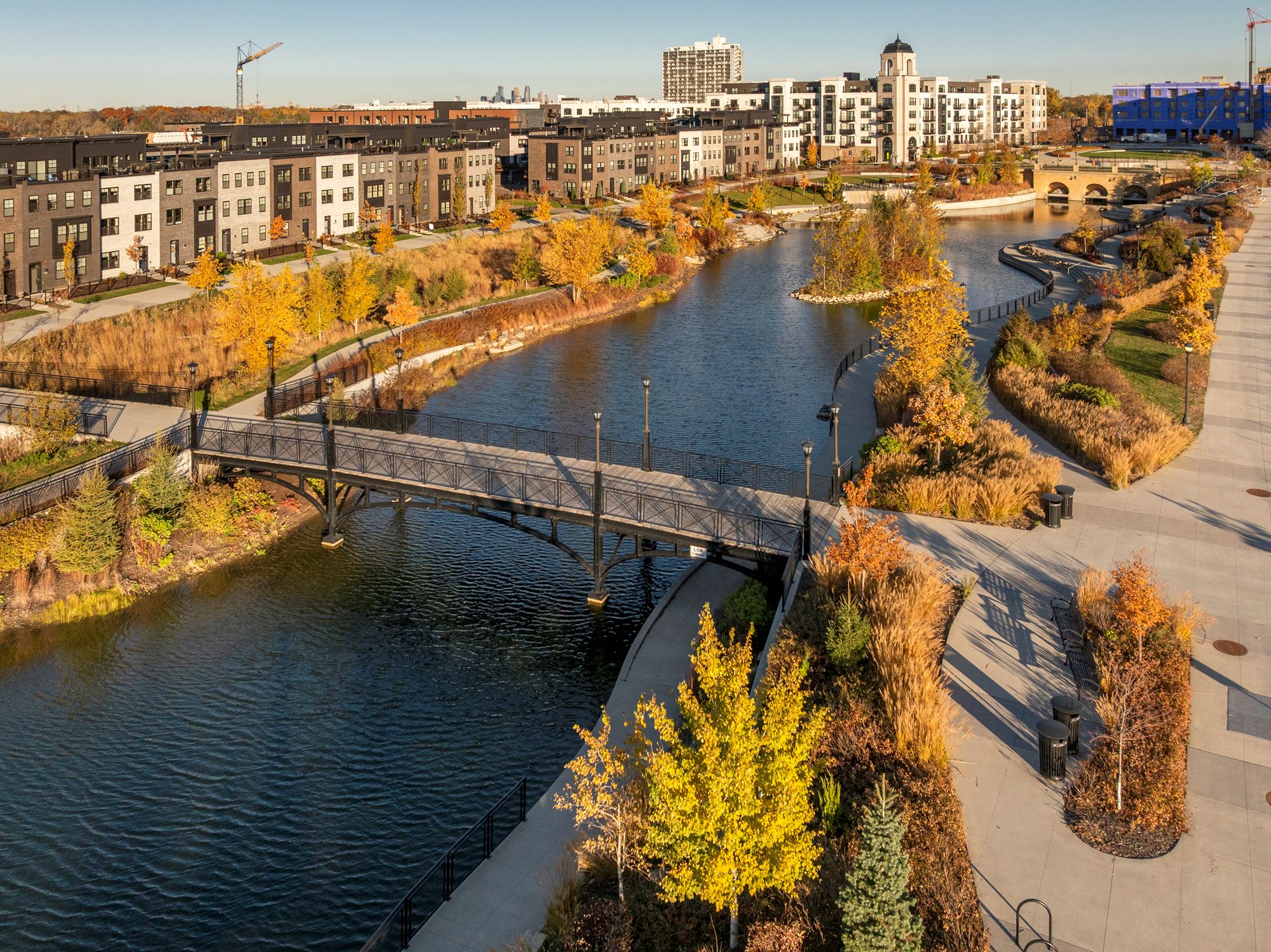
At the surface, that river ecology becomes the public landscape. Treated water gathers in the central feature, a civic focal point framed by seating and water-edge access. It flows around an island and beneath pedestrian bridges where people kayak in summer and skate in winter. From there, the daylighted Hidden Falls Creek winds through native planting and groves of trees, with paths and gathering spaces along its banks. Farther downstream, sculptural overflow structures inspired by Fordite, the colorful layers of hardened automotive paint built up during decades of automobile production, turn necessary infrastructure into a visible trace of the site’s industrial history.
The character of the landscape changes as water moves south through Highland Bridge. At Uŋči Makhá (Great Grandmother) Park, the civic waterway gives way to a rugged limestone ravine that serves as a storm-event basin during larger storms. During ordinary conditions, visitors can descend into the ravine, follow the creek, and cross the limestone along a route that is intentionally less formal than the paths above. Excavation exposed groundwater, fossils, and bands of bentonite associated with an ancient volcanic event, and those discoveries became part of the landscape rather than being covered over.
“At first,” Terry Minarik, principal in charge, said, the excavation resembled “a big hole of rock.” Contractors shaped and arranged the exposed and excavated stone. Water was temporarily withheld from portions of the ravine to establish native vegetation. As that vegetation grew through the limestone, the engineered basin began to read as a living creek landscape.
“Once you’re in the ravine, you don’t realize where you are because you have no context of buildings and development,” Minarik said. “It just feels natural.”
Limestone removed during excavation was reused along the central water feature, planted edges, outfalls, and crossings. The stone carries the character of the ravine throughout the public realm.
Across Highland Bridge, the project reestablished living habitat on land once occupied by industry. Reconstructed soils support more than 1,000 new trees and 132 plant species, 95% native to Minnesota. Tamarack groves create shaded wetland habitat. Pollinator lawns provide food for bees and other insects with less irrigation and maintenance than conventional turf. Along the creek banks and within the stormwater basins, planting responds to changing water levels, helping clean runoff and create cover for wildlife.
Although the landscape was created through extensive remediation and engineering, it now feels rooted. “When you go there now, it feels like it’s always been there,” Minarik said. “If you were there ten years ago, you’d never believe it.”
Building the Neighborhood Around the Public Realm
Highland Bridge reversed the usual sequence of development. Because the district-scale stormwater system had to be constructed before buildings could rise, the parks and water landscape came first. They established the framework for the streets, development parcels, and buildings that followed. The public realm was “the heart of the development,” Minarik explained. It was established first, and the neighborhood grew around it.
That public realm was built around infrastructure most people never see. A large underground storage and filtration vault had to be placed at the water’s edge. Confluence designed the ground above the vault as Civic Plaza, a gathering space. Elsewhere, the team shaped a play area and dog park over other vaults and utilities. Coordinating those layers of infrastructure and public use required close collaboration among Confluence, Ryan Companies, the City of Saint Paul, Barr Engineering and Capital Region Watershed District.
A decade-long public process, including more than 200 community events, helped define how that shared landscape should support daily life. The neighborhood now includes approximately 3,800 homes, 20% of them affordable. Its parks and gathering places remain open to surrounding communities.
Across the district, the connected park system provides the play, active recreation, and gathering spaces those communities had long lacked. Gateway Park pairs prairie planting with skateboarding and other active recreation at the northern edge. Near the center, Assembly Union Park provides play environments and courts. At Uŋči Makhá Park, playgrounds, climbing boulders, bridges, and picnic areas extend public use into the ravine landscape.
For generations, the Ford Assembly Plant occupied a large private tract with limited public access. Highland Bridge replaced that barrier with accessible routes for walking and biking that draw people through the district from surrounding neighborhoods to Hidden Falls Park and the Mississippi River Trail. “It turns a single use into something cherished by many,” said Jake Coryell, project manager. The National ASLA Award recognizes the landscape-led transformation of a closed industrial tract into a public landscape where water now supports habitat and public life.